Tennis Elbow Treatment in New Jersey
Page Navigation
Page Navigation
What Is Tennis Elbow?
Tennis elbow, also called lateral epicondylitis, is pain on the outer bump of the elbow where the forearm tendons attach to the bone. Repeated gripping and wrist motions overload those tendons, creating tiny tears and irritation that build over time.
Despite the name, only about 5% of cases actually come from tennis. Most start at work or during hobbies that overload the arm, and it shows up most often in adults over 30. Left alone, it can make everyday actions like gripping a coffee mug or turning a doorknob genuinely painful. Catching it early keeps a manageable problem from becoming a chronic one.

What Causes Tennis Elbow?
Tennis elbow comes from repeated strain on the forearm muscles, and specifically on the extensor carpi radialis brevis (ECRB) tendon. Tiny tears build up where that tendon attaches to the bone from forceful gripping, twisting, or repeated wrist motions without enough rest. Tendons also lose elasticity and heal more slowly with age, which is why it so often appears in midlife.
- Overuse in racket sports or throwing
- Manual jobs like plumbing, carpentry, or painting
- Long hours of typing or mouse use
- A sudden forceful arm twist or impact
- Poor technique at work or in a hobby
What Does Tennis Elbow Feel Like? (Symptoms)
Tennis elbow usually starts as tenderness on the outer bump of the elbow that gets worse when you grip, twist, or lift the wrist. The pain often spreads down the forearm as a burning ache, and grip weakness sets in, so light objects can slip from your hand. The pain centers on the outer (lateral) side of the elbow and can travel into the forearm.
- Pain or burning on the outer bump of the elbow
- Forearm ache that worsens with gripping or twisting
- A weak grip that drops light items like a book or mug
- Stiffness after rest that eases with movement
- Pain when lifting or straightening the wrist
Custom Orthopedic Treatment Made for You, with You
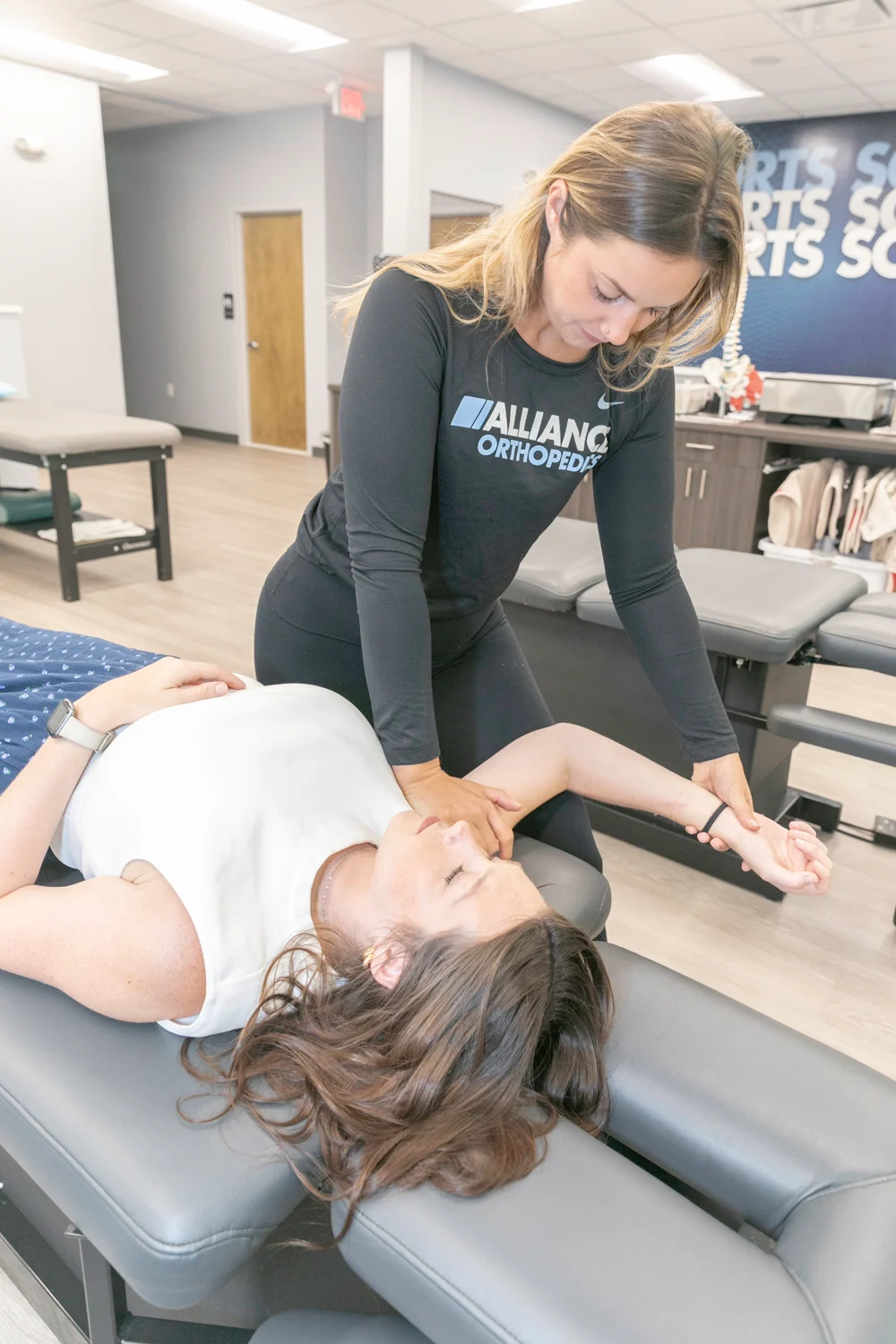
Choose Alliance Orthopedics for care that revolves around you. We listen, collaborate, and create a custom orthopedic treatment plan that fits your life, your goals, and your recovery!
Tennis Elbow vs. Golfer's Elbow
Tennis elbow and golfer’s elbow are the same kind of tendon injury on opposite sides of the elbow. Tennis elbow (lateral epicondylitis) affects the outer elbow and the tendons that extend the wrist. Golfer’s elbow (medial epicondylitis) affects the inner elbow and the tendons that flex the wrist. Knowing which side hurts points to the right diagnosis and treatment.
How Tennis Elbow Is Diagnosed
Diagnosis starts with a discussion of your history of repetitive arm activities, followed by a hands-on exam where the provider presses the outer elbow to find the tender spot. No single test confirms tennis elbow, so the provider first rules out arthritis, nerve compression, and fractures. Imaging like ultrasound or MRI comes next only if symptoms persist.
Physical exam: The provider presses over the bony bump on the outside of your elbow (lateral epicondyle) and along the tendon to find where it is most tender, then checks strength, motion, and grip to confirm the symptoms match tennis elbow rather than another elbow or nerve condition.
Cozen’s test: With your elbow bent and forearm turned palm-down, the provider asks you to lift (extend) your wrist against resistance while stabilizing the elbow, watching for a sharp, familiar pain at the outer elbow that points strongly to tennis elbow.
Mill’s test: Your elbow is straightened while your wrist and fingers are gently bent downward, putting a stretch on the forearm extensor muscles. Pain at the lateral epicondyle during this stretch supports the diagnosis.
X-ray: A simple X-ray looks at the bones and joint to rule out arthritis, bone spurs, or fractures that can mimic outer elbow pain, even though the tendon itself does not show up clearly.
Ultrasound / MRI: Imaging can show tendon thickening, small tears, or inflammation when the diagnosis is unclear or symptoms are severe. Ultrasound gives a dynamic, in-office view of the tendon, while MRI shows the tendon and surrounding soft tissues in detail.
Non-Surgical Tennis Elbow Treatments in NJ
Most tennis elbow improves without surgery at Alliance Orthopedics’ New Jersey clinics. A counterforce brace takes stress off the tendon during daily tasks, and targeted exercises like eccentric wrist curls rebuild forearm strength over time. Injections such as cortisone or PRP can help stubborn pain. About 90% of patients recover fully within 6 to 12 months and resume work and sport pain-free.
Short breaks from painful activities paired with regular ice help quiet the irritated tendon. Brief rest protects the tissue so it can start healing, and 10 to 15 minutes of ice several times a day reduces swelling and dulls the elbow pain.
Nonsteroidal anti-inflammatory drugs such as ibuprofen or naproxen reduce both pain and inflammation in the irritated tendon. Taken as directed by your provider, they can make daily tasks and therapy exercises more tolerable while the tissue heals.
A counterforce brace wraps around the upper forearm, about an inch or two below the elbow, to shift stress away from the injured tendon. Positioned correctly and worn during activity, it decreases pain each time you grip or lift and gives the healing fibers a chance to recover.
Targeted physical therapy focuses on eccentric exercises, where the muscle lengthens while working, like slowly lowering a weight during a wrist curl. These drills remodel the damaged tendon, restore flexibility, and build durable forearm strength to prevent future flare-ups.
Cortisone injections deliver anti-inflammatory medicine directly to the painful tendon attachment for quicker relief of stubborn symptoms. Platelet-rich plasma (PRP) uses a concentrated sample of your own blood platelets to support tendon healing in chronic cases when standard care is not enough.
Tennis Elbow Exercises and Stretches
Specific stretches and strengthening exercises are one of the most effective ways to treat tennis elbow and keep it from coming back. The goal is to gradually rebuild the forearm extensor tendons, and eccentric exercises, where the muscle lengthens under load, are the evidence-based core. Start slow, and stop if the pain sharpens. A physical therapist can tailor the progression to where you are in recovery.
- Eccentric wrist extension: rest your forearm on a table, palm down, and slowly lower a light weight, then use the other hand to reset
- Wrist extensor stretch: straighten the arm and gently bend the wrist down until you feel a stretch along the top of the forearm
- Forearm rotations: with a light weight, slowly turn the palm up and down
- Grip strengthening: squeeze a soft ball once the sharp pain has settled
Tennis Elbow Surgery in NJ
Surgery helps the 5 to 10% of patients whose tennis elbow does not improve after 6 to 12 months of non-surgical care like therapy or injections. Alliance Orthopedics uses minimally invasive techniques that remove only the damaged tendon tissue while preserving the healthy part, which supports a faster, smoother recovery. These are outpatient procedures, so you go home the same day and begin light rehab soon after.
Through a small incision over the outside of the elbow, the surgeon sees the damaged portion of the tendon directly and trims away the frayed, degenerated tissue while preserving healthy fibers. Smoothing this area reduces pain and improves tendon gliding.
Using a small camera and pencil-sized instruments through keyhole incisions, the surgeon views the tendon on a screen and removes scarred tissue without a large cut. This minimally invasive approach often means less pain, faster motion, and less scarring.
The surgeon partially cuts or lengthens the tight tendon where it attaches to the bone so it is no longer overstressed with each grip or lift. Reducing that constant tension eases pain and lets the remaining healthy fibers share the load. It is often combined with debridement.
In more severe or repeat cases, the surgeon may reposition part of the nearby anconeus muscle to support the weakened tendon. This adds strength and stability to the outer elbow and is most often used for patients who have had previous unsuccessful treatment.
How Long Does Tennis Elbow Last? (Recovery)
Most tennis elbow improves within 6 to 12 months, and non-surgical recovery usually moves through clear stages over 4 to 12 weeks. How fast you heal depends on resting the tendon early and staying consistent with rehab.
Non-surgical recovery starts with a brace worn for 2 to 6 weeks to rest the irritated tendon. Therapy then focuses on eccentric exercises like slow weighted wrist drops to rebuild extensor strength safely. Ice and NSAIDs manage flare-ups, and most patients are working, playing sports, and doing their hobbies at full strength by about 3 months, especially when they pair rehab with ergonomic changes like a better mouse grip.
Surgical recovery is quick to start. Patients go home the same day and begin light therapy in week 1 after sutures are removed. Heavy lifting waits about 6 weeks, and grip strength typically rebounds by 8 to 12 weeks through guided sessions. Alliance Orthopedics coordinates rehab at its NJ clinics with close monitoring for the best outcome.
Tennis Elbow FAQs
Often, yes. Many cases improve on their own with rest and activity changes, but it can take many months and may return without rehab. Strengthening the forearm tendons is what keeps it from coming back, so most people recover faster with guided treatment than by waiting it out.
Tennis elbow clears up within 6 to 24 months for about 90% of people, and therapy can shorten that to 3 to 6 months. If pain lingers, injections can help kickstart healing. Track your progress weekly, and if there is no real improvement by 3 months, it is time to reassess.
Night pain comes from inflammation that is more noticeable without daytime distractions, plus reduced blood flow during rest. Fluid in the irritated tendon can press on nearby nerves. Elevate your arm, ice before bed, take NSAIDs as advised, and avoid sleeping on the sore arm. Therapy improves circulation and eases this over time.
Tennis elbow affects the outer elbow, while golfer’s elbow affects the inner elbow. Both come from overused forearm tendons and are treated in similar ways. The side of the elbow that hurts is the quickest way to tell them apart.
Yes. Roughly 20 to 50% of patients develop symptoms in both arms, often from symmetric activities like typing. It usually appears first in the dominant arm, which takes more strain. Early treatment helps prevent it from worsening on both sides, and Alliance Orthopedics screens both arms during your evaluation.
No. With proper treatment, most people restore up to about 95% of their grip and forearm strength. Untreated chronic tears can cause lasting weakness, but therapy rebuilds the extensors effectively. Combined with post-surgery rehab when it is needed, it supports a full, lasting recovery.
Untreated tennis elbow can become chronic, with ongoing pain and lasting grip weakness as the small tendon tears build up. Early treatment is the best way to avoid a longer, harder recovery.
What Makes Alliance Orthopedics the Best Choice for Tennis Elbow Treatment in NJ
Alliance Orthopedics treats tennis elbow with muscle-sparing arthroscopy that cleans the damaged tendon without disturbing healthy tissue. Small incisions mean less pain and no muscle cutting, and many patients are lifting light weights within days of surgery. On-site ultrasound pinpoints the tear so that treatment is precise, which can shorten recovery time.
Fellowship-trained elbow specialists combine PRP injections and eccentric therapy protocols that go beyond basic physical therapy. Clinics across New Jersey make follow-ups simple and close to home.

Elbow Surgeons in New Jersey
Alliance Orthopedics’ fellowship-trained elbow surgeons treat tennis elbow with minimally invasive repairs across New Jersey. Techniques that preserve muscle deliver faster strength recovery and smoother motion than conventional approaches.


Elbow Clinics in New Jersey
Alliance Orthopedics’ elbow clinics in Bloomfield, East Brunswick, Fair Lawn, Freehold, Middletown, Old Bridge, Randolph, Toms River, and Union feature diagnostics, injections, and rehab under one plan for tennis elbow care close to home.
Other Elbow Conditions We Treat
Tennis elbow is one part of the connected elbow care our New Jersey team provides. We also diagnose and treat golfer’s elbow, cubital tunnel syndrome, elbow bursitis, elbow sprains and strains, and elbow fractures. Learn more about the full range of elbow pain conditions we treat and our elbow pain treatment options.