

Ankles carry the weight of your world. Whether you’re dashing across a soccer field, navigating stairs in a rush, or simply taking a misstep, it doesn’t take much for your ankle to get hurt. Injuries can happen in an instant, and in that moment, it’s often tough to know what really went wrong. Did you just sprain your ankle, or could it be broken? The symptoms can look (and feel) alike, leaving plenty of people guessing. Knowing the difference between a sprained ankle and a broken ankle is important because how you treat each injury, and how soon you get help, can mean a faster recovery.
Understanding How Ankle Injuries Happen
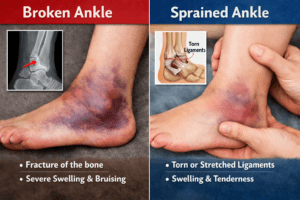
Before jumping into the symptoms and differences, let’s break down what’s actually happening inside your ankle when you get hurt. Your ankle joint is a complex structure where the tibia (shinbone), fibula (outside leg bone), and talus (foot bone) meet. Ligaments, tough bands of tissue, hold these bones together and stabilize your movement. Let’s take a look at the basic difference between a sprain and a break:
What Is a Sprained Ankle?
A sprain is what happens when one or more of the ligaments around your ankle are stretched beyond their limits, and sometimes torn, by a sudden twist or roll. Most commonly, the foot turns inward, stretching the outer ligaments. This can happen during sports activities, while stepping on uneven ground, or even during daily routines. Severity can range from a mild stretch to a complete ligament tear.
What Is a Broken Ankle (Ankle Fracture)?
A broken ankle means one or more of the bones in the joint are cracked, chipped, or fully broken. This can happen from falls, heavy blows, car accidents, or anything that forces the bones past their breaking point. A broken ankle usually involves more visible changes to the ankle’s shape, as the bone itself is damaged.
What’s Happening Inside the Ankle After an Injury?
During a sprain, the main problem is overstretched or torn ligaments. The bones stay intact, but the surrounding soft tissues are damaged. This can result in a loose, unstable feeling in your ankle and can make simple movements painful. When an ankle is broken, there’s damage to the bone, anything from a hairline crack to a bone completely out of place. This may cause the ankle to look deformed, and movement becomes extremely painful. Sometimes the broken bone can even puncture the skin, which is called an open fracture.
Sprained Ankle vs. Broken Ankle: How to Tell the Difference
Even though both injuries hurt and can make everyday life difficult, there are specific clues that help you tell them apart.
Pain Level & How it Starts
- Sprained ankle pain is usually less sharp at first, as it might throb, swell, or increase over hours. You may still be able to move the ankle or limp, even though it hurts.
- Broken ankle pain is often sudden, intense, and overwhelming at the time of injury. Any attempt to walk or move usually increases pain dramatically and may be impossible.
Swelling & Bruising
- With a sprain, you’ll often see swelling around the outside of the joint, sometimes paired with bruising. Swelling usually develops over several hours.
- Broken ankles cause more immediate and dramatic swelling, and bruising often spreads further, sometimes into the foot or toes. The swelling is usually accompanied by noticeable deformity.
Ability to Walk or Bear Weight
- Sprains may allow you to put some weight on your ankle, though limping is common, and walking may be awkward.
- Breaks usually make walking impossible; any attempt results in severe pain or the ankle giving way immediately.
Visual Signs & Deformity
- Sprained ankles may look puffy or discolored, but rarely misshapen.
- Fractures often result in visible distortion: the ankle may look crooked or twisted, or the bone may protrude if the break is severe.
Sounds at Time of Injury
- Sprains might be accompanied by a popping sound as the ligament stretches or tears.
- A break usually comes with a distinct crack or snap, sometimes loud enough for others nearby to hear.
Location of Pain
- Sprained ankles hurt more in the flexible, soft parts of your ankle, where the ligaments are.
- Broken ankles are usually more painful over the bony areas.
Other Symptoms (Numbness/Tingling)
- Sprains generally cause throbbing or aching, but rarely tingling.
- Fractures may lead to tingling or numbness if nerves are compressed or the injury is severe.
Sprained Ankle vs. Broken Ankle: Quick Comparison
| Symptom / Sign | Broken Ankle | Sprained Ankle |
| Pain level | Sharp, intense pain at the time of injury | Mild to moderate pain that increases with activity |
| Swelling & bruising | Major swelling and bruising that may extend beyond the ankle | Swelling and tenderness, mostly around the outer ankle |
| Ability to bear weight | Unable to bear any weight | Often able to walk, but with discomfort or limping |
| Appearance | Visible deformity or bone protruding in severe cases | Puffy or bruised, but rarely misshapen |
| Numbness or tingling | May be present due to nerve involvement | Rare |
| Sound at injury | Hearing a clear crack or snap | Possible popping sound or sensation |
| Joint stability | Feels unstable due to structural damage | Instability or “giving out” sensation |
| Pain location | Pain concentrated over the bone | Pain in soft tissue around the joint |
When to See a Foot and Ankle Specialist
Some ankle injuries can be treated at home with rest, ice, and elevation, but it’s essential to know when professional help is necessary. If any of the following are true, reach out right away to a foot and ankle specialist:
- You cannot put any weight on the ankle, even for a few steps
- Pain is severe, constant, or increasing over several hours
- The ankle looks misshapen, twisted, or you notice any deformity
- There’s extreme swelling or bruising, or the skin is punctured by bone
- You feel numbness or tingling that does not go away
- You heard a clear crack or snap when the injury happened
How Doctors Diagnose a Sprained Ankle vs. a Broken Ankle
It’s not always easy to decide which injury you have on your own. Doctors use a combination of your medical history, physical examination, and imaging (like X-rays or MRIs) to make an accurate diagnosis. You may be asked to describe the incident, your pain, and how your ankle feels. Sometimes a broken ankle might still be mistaken for a sprain, especially if there’s no apparent deformity, so professional evaluation is critical.
Treatment Options for Sprained Ankle
Most sprained ankles are treated with the R.I.C.E. method: Rest, Ice, Compression, and Elevation. Mild sprains may heal within a few weeks, while more serious ligament tears can take longer and may benefit from physical therapy. Your provider might suggest:
- Using crutches if walking is painful
- Wrapping the ankle for support
- Brief use of anti-inflammatory medications
- Gradual return to activities, starting with gentle range-of-motion and strengthening exercises
If ligaments are severely torn or the joint remains unstable, surgery or immobilization may be necessary to treat a broken ankle.
Treating a Broken Ankle
A broken ankle usually needs more protection and patience. How it’s treated depends on how severe the break is and whether the bones are still aligned correctly. Some fractures can heal with a cast or walking boot that keeps the ankle immobilized while the bone heals. In other cases, the bones may need realignment, and sometimes surgery is the best way to ensure everything heals in the right position.
At first, you’ll likely need to stay off your ankle and use crutches or a walker. As healing progresses, physical therapy helps you regain strength, movement, and balance so you can get back to walking comfortably.
What Recovery Looks Like After a Sprain or a Break
Sprains usually heal within a few weeks to several months, depending on severity. You’ll gradually return to normal activities, potentially with stretching and strengthening exercises, to rebuild stability. Swelling and bruising resolve, and with proper care, most people regain full function.
Broken ankles require more patience. Healing may take 6 to 12 weeks, and more for severe cases. Regaining full strength and stability can require several months of physical therapy. The goal is proper bone alignment and joint restoration to prevent future problems like arthritis or recurring pain.
Get Expert Ankle Care at Alliance Orthopedics
At Alliance Orthopedics, our expert foot and ankle surgeons make diagnosing your injury as stress-free and straightforward as possible. They’ll listen closely to your experience, thoroughly examine your injury, and use state-of-the-art imaging technology to clarify whether you’re dealing with a sprained ankle or a broken ankle. From the minute you walk in, you’ll have a care team dedicated to minimizing pain and maximizing your comfort.
If you’re facing stubborn pain, swelling, or can’t walk normally, don’t wait; let the specialists at Alliance Orthopedics help you get back on track. The team offers a full spectrum of services, from conservative treatment for sprained ankles to fracture management, including both nonsurgical and surgical options. You’ll be guided every step of the way, with clear answers and personalized recovery plans. Schedule an appointment today to move forward with confidence and let the healing begin.