

When shoulder pain starts to control your life, everything changes. You may not be able to sleep, reach, or even lift. You start planning your day around your shoulder pain, instead of what you actually want or need to do.
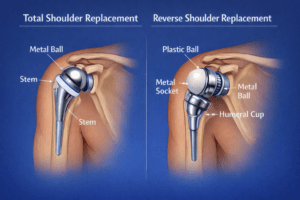
If your doctor has recommended shoulder replacement surgery, one of the first questions you’ll likely hear is:
Do you need a total shoulder replacement or a reverse shoulder replacement?
At Alliance Orthopedics, our shoulder specialists help patients across New Jersey determine which procedure is right for them based on their type of shoulder damage. Understanding the difference can help you feel more confident about your treatment options.
What is a Shoulder Replacement?
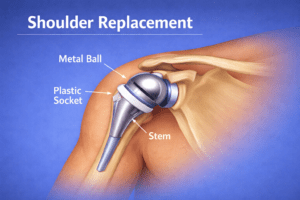
A shoulder replacement, also called an anatomic shoulder replacement, is designed to mimic the natural anatomy of your shoulder joint.
In a healthy shoulder:
- The ball sits at the top of your upper arm bone
- The socket is part of your shoulder blade
- The rotator cuff muscles help keep everything stable and moving smoothly
During a total shoulder replacement surgery:
- The damaged ball is replaced with a metal ball
- The damaged socket is replaced with a plastic component
- The normal structure of the joint is preserved
This procedure works extremely well for patients who have:
- Severe shoulder arthritis
- Intact and functioning rotator cuff tendons
- Strong enough bone quality that can support the implant
When the rotator cuff is healthy, a traditional replacement can restore motion, reduce pain, and provide strong long-term outcomes.
However, the success of the procedure depends heavily on a healthy rotator cuff.
When Rotator Cuff Damage is the Problem
Many patients with shoulder pain don’t just have arthritis. They also have large or irreparable rotator cuff tears.
The rotator cuff is a group of muscles and tendons that stabilize your shoulder and help lift your arm. When your rotator cuff is severely damaged, a traditional shoulder replacement may not work properly.
Without a working rotator cuff:
- The joint can become unstable
- Motion may remain limited
- Pain can persist
This is where reverse shoulder replacement changes the game.
What Is Reverse Shoulder Replacement?
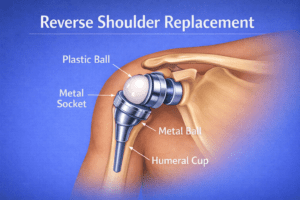
Reverse shoulder replacement was designed specifically for patients with severe rotator cuff damage.
Instead of copying your shoulder’s natural anatomy, this procedure flips it and reverses the position of the ball and socket.
In a reverse shoulder replacement:
- The ball component is attached to the shoulder blade
- The socket component is attached to the upper arm bone
This reversal allows a different muscle, the deltoid, to power the shoulder instead of the damaged rotator cuff.
That shift makes all the difference.
Many patients who previously could not lift their arm at all often regain function and independence.
The Difference Between Reverse Shoulder Replacement and Shoulder Replacement
| Feature | Shoulder Replacement | Reverse Shoulder Replacement |
| Joint structure | Maintains normal anatomy | Ball and socket positions reversed |
| Muscle used for movement | Rotator cuff | Deltoid muscle |
| Best for | Arthritis with intact rotator cuff | Rotator cuff tears or cuff tear arthritis |
| Stability | Depends on the rotator cuff | Designed for rotator cuff failure |
The biggest difference between total and reverse shoulder replacement is this:
Traditional replacement relies on the rotator cuff; reverse replacement does not.
That single difference determines which surgery will give you the best outcome.
How Your Shoulder Surgeon Decides Which Surgery You Need
Choosing the right procedure requires a detailed assessment of your shoulder.
At Alliance Orthopedics, Dr. Roman Ashmyan, our trusted shoulder, elbow, and knee specialist, carefully evaluates:
- The condition of your rotator cuff
- The degree of arthritis
- Your bone quality
- Your activity level
- Your goals
From there, he’ll recommend whether you need a traditional or reverse shoulder replacement for your specific condition.
How Long Does Shoulder Replacement Last?
Longevity matters. Traditional shoulder replacements have excellent long-term results when performed on the right patient. Many shoulder replacements can last fifteen to twenty years, or longer!
Reverse shoulder replacements, however, have shown remarkable durability, especially in patients with complex rotator cuff damage. Advances in implant design and surgical techniques have allowed reverse shoulder replacements to last twenty years or more in many cases.
For patients who previously had limited options due to rotator cuff failure, reverse shoulder replacement is not just a solution; it is often a longer-lasting, more reliable solution than traditional replacement in that specific population.
Because surgery is not just about fixing today, it is about protecting your tomorrow.
When Is a Shoulder Replacement Necessary?
You may be a candidate for a shoulder replacement if you:
- Have severe arthritis
- Have an intact rotator cuff
- Have pain that has not improved with conservative treatment
You may be a candidate for reverse shoulder replacement if you:
- Have a massive rotator cuff tear
- Have a rotator cuff tear and arthritis
- Have failed a previous shoulder replacement
- Cannot lift your arm due to cuff damage
The key is precision. The right diagnosis leads to the right procedure. The right procedure leads to the right outcome.
Find the Right Shoulder Surgeon in New Jersey
At Alliance Orthopedics, our mission is simple:
Relieve pain. Restore motion. Help you get better every day.
Whether that means lifting your grandchild, returning to the gym, or finally sleeping through the night without shoulder pain, the mission remains the same.
If you’re struggling with persistent shoulder pain, stiffness, or weakness, our shoulder surgeon, Dr. Roman Ashmyan, can help determine whether shoulder replacement or reverse shoulder replacement is the best solution.
Please request an appointment with Dr. Ashmyan at one of our orthopedic clinics in New Jersey for expert shoulder care and to help reclaim your independence, activity, and confidence.